
Short answer: Google is moving Local Services Ads (LSAs) out of their own dashboard and into Google Ads as a Performance Max campaign with pay-per-lead goals. You still pay per lead, not per click, but manual cost-per-lead bidding goes away, your old LSA reports won't carry over, and since October 1, 2026 some missed calls are billed as leads. If your practice runs Local Services Ads for dentists, the work to do now is phones, hours, and measurement, before your migration email arrives.
Google hasn't published a migration date for healthcare. That's the good news: dental practices have time to prepare instead of reacting. Here is what changes, what stays the same, and the checklist we're running for the practices we manage.
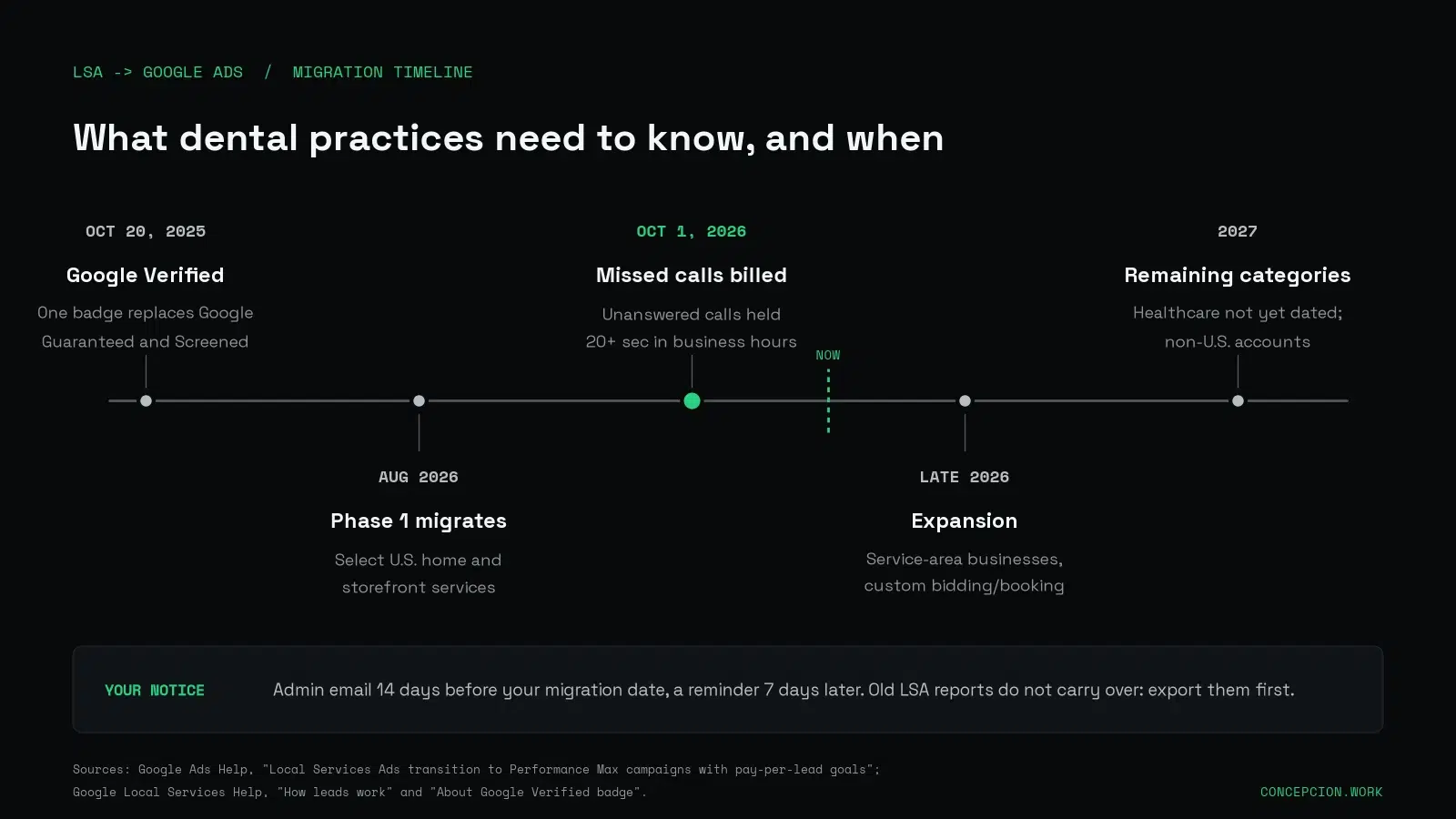
What's actually changing
According to Google's migration documentation, existing LSA campaigns are being moved automatically into a specialized Performance Max campaign type built for pay-per-lead goals. The rollout runs in phases:
- August 2026: select U.S. home and storefront service advertisers (plumbing, HVAC, roofing, pest control and similar).
- Late 2026: broader groups, including service-area businesses and accounts with custom bidding or booking setups.
- 2027: non-U.S. accounts and all remaining categories not migrated in 2026.
Healthcare isn't named in the first phase, and Google's page gives no healthcare-specific timeline. Plan as if your dental account could move any time between now and 2027.
Bidding and budgets
- Manual bidding is gone. You can no longer set a maximum cost per lead. New campaigns default to Maximize Conversions, and Google's best-practice guide suggests only adding a Target CPA once a campaign consistently gets more than 15 leads a month.
- One target per campaign. Vertical-level Target CPA isn't supported. If you ran a higher target for implants and a lower one for general dentistry inside one campaign, Google will apply a single blended target. To keep them separate, split them into separate campaigns.
- Weekly budgets become daily averages. Your weekly budget is divided by 7, and monthly spend is capped at the daily average times 30.4. Pacing that used to smooth out over a week now shows up day to day.
Reporting and leads
- Old performance reports don't migrate. Past impressions, clicks, weekly spend and ad-level reports stay behind, and the LSA dashboard closes after migration. Google says a download option is coming and suggests screenshots if you need data now.
- Lead history does transfer. Contact details, message threads and older call recordings move into the new Leads table in Google Ads (Goals, then Conversions, then Leads).
- Google Business Profile becomes the source of truth. Name, address and hours sync one way from your Business Profile into Google Ads. Big changes to name, address or primary category trigger a 24–48 hour verification review, and the campaign can pause during it.
What stays the same
- You still pay only for valid leads (calls and messages), not clicks.
- Ads still show only on Google Search and Google Maps, in the same positions.
- Targeting is still keywordless, based on service categories and service areas.
- Your verification and Google Verified badge transfer automatically.
The change that costs dental practices money: missed-call billing
This one isn't part of the migration, but it hits at the same time. Under Google's updated "How leads work" rules, a call you miss during your stated business hours is charged as a lead if the caller stays on the line for more than 20 seconds. Search Engine Land reported that the rule took effect October 1, 2026.
The details that matter for a dental front desk:
- Phone menus: if callers must press a key to be routed, the 20-second timer starts at the key press. No key press, no charge.
- Answered calls are judged on the conversation, not ring time.
- Follow-ups: once a lead is charged, further calls or messages with that patient within 15 days aren't charged again. After 15 days of no activity, a new contact can create a new charged lead, as Google's Ads Liaison clarified.
Translate that into a normal practice day. Lunch hour when the front desk is thin. A hygienist covering the phone during a cleaning. Saturday hours listed on your profile but staffed by one person. Each of those is now a moment where you can pay for a patient you never spoke to. And because calls are a required goal, Google says responsiveness also drives your ad performance and local ranking. A missed call costs you twice.
Why "conversions" will mislead you
In the new setup, the number Google labels "conversions" is simply the leads you were charged for. As Invoca points out for healthcare advertisers, that's not appointments booked or patients acquired. Invoca also notes Google call recording is disabled for healthcare advertisers, which limits how much you can review or dispute inside the platform.
So if you judge LSAs by Google's dashboard alone, a missed-call-heavy month can look like a great month. The metric that survives this change is cost per booked appointment: what you spent, divided by patients who actually got on the schedule. It's the number we report on for every practice we manage, because it's the one a practice owner can act on.
What we've seen fix this
The fixes are operational, not ad settings. In the accounts we run, routing every form, call and chat into one queue with instant drafted replies brought median first reply from 4 hours 12 minutes to 61 seconds, and lifted lead-to-booked rate from 23% to 37%. After-hours inquiries made up 41% of leads, which is exactly the window where missed calls now cost money. Cost per booked call fell from $142 to $88 over the same period.
None of that required a bigger budget. It required answering faster and measuring the right number.
Your pre-migration checklist
- Export your LSA history now. Download or screenshot monthly leads, spend and cost per lead by service. You'll want a baseline after migration.
- Match posted hours to real phone coverage. Go hour by hour, location by location. If you can't staff an hour you've posted, cover it (overflow, answering service or an AI voice agent) or remove it from your hours.
- Fix the lunch hour and Saturdays first. These are the most common gaps in dental offices.
- Check your phone menu. A short "press 1 for new patients" step keeps unrouted hang-ups from being billed and gets new patients to scheduling faster.
- Set a response target. Missed calls returned within five minutes; text messages answered immediately. Name an owner for each location.
- Decide on campaign structure. If implants, Invisalign and general dentistry need different targets, plan separate campaigns before Google blends them.
- Clean up your Google Business Profile. Hours, phone number, categories and services now feed your ads directly. Make changes before migration, not during.
- Track bookings, not leads. Tag every lead: booked, existing patient, wrong service, out of network, spam, missed then recovered. Compare Google's charged leads with your schedule every month.
- Watch for the email. Your account admin gets notice 14 days before migration and a reminder 7 days later. Make sure that inbox is one someone reads.
- Give it two weeks. Google says performance can take up to two weeks to stabilize after migration. Don't make big budget calls in that window.
FAQ
When will dental Local Services Ads migrate?
Google hasn't given a date for healthcare. Its documentation lists remaining categories for 2027, with broader groups expanding in late 2026. You'll get an email 14 days before your account moves.
Will my LSA costs go up?
Not because of the migration itself; it's still pay per lead. Costs can rise if you miss calls during business hours, since those can now be charged when the caller holds more than 20 seconds.
Do I lose my reviews or Google Verified badge?
No. Verification and the badge transfer automatically, and your Google Business Profile details sync into Google Ads.
Can I still set different bids for implants and cleanings?
Only by using separate campaigns. Manual bidding and per-category targets aren't supported in the new campaign type.
Should we stop running LSAs?
Not by default. For most practices LSAs still sit at the top of local searches and charge per lead. Fix phone coverage and measurement first, then judge them on cost per booked appointment.
Want a second set of eyes before your migration?
We'll review your LSA setup, posted hours and call handling, and tell you where you're paying for patients you never talk to. See what we do on our services page, or get in touch and email allan@concepcion.work with your practice name.